Saturday, 13 October 2012

Character Thumbnail Sketches

Here are a few quick character thumbnail sketches to possibly assist Anita in designing our final narrative protagonist, Charles. In our team we have delegated specific tasks to each individual but still felt that if everyone created a few thumbnails in terms of character and environment it would allow a more creative final design.  


Friday, 12 October 2012

Unit 7: Narrative - Character Sketches

Here is my progress on the character sketches. I struggled getting into the flow of character design however, I feel as though the sketches have improved. The last face on the left is the one that we have decided to develop as he has potential to be a happy and sad character that the audience can empathise towards.


While working on the face, I drew four costume ideas. The group preferred the third costume however, this may be changed. I then took the preferred face and outfit and put the two together, finally adding colour.


This is not the final character as I still need to refine his features. Photoshop Phill suggested changing the eyes and moving the features around. He also emphasised the point of using silhouettes to improve the face and figure. The next stage will be to refine the current design to give the boy more character.

Unit 7: Narrative - Week 3 Tutorial

On Thursday, we had a group meeting with our tutor, Alan, in which some of the following points were raised:
  • "Reduction is the way to go". Consider less camera movements and less cutting. If there are cuts, there should be a reason for them.
  • We were worried that transitions in the background would be too obvious e.g. a tree transforming into a metal pipe. However, Alan suggested watching the video below to emphasise the point that if the viewer is distracted in the foreground, changes can be made without being noticed.
                               
  • How much is the boy, Charles, going to move? Is he going to be static? Running around?
  • Could the boy be walking with objects changing around him? This is a similar idea to a scene from Fight Club (1999).
          

Unit 7: Narrative - Rough Initial Storyboard

Before Stitch began creating the final storyboard for the animatic, me and Lydia drew out how we visualised the storyboard (unfinished). This was then passed on to Stitch to draw up the final version which is currently being finished off and will be posted soon.


Saturday, 6 October 2012

Unit 7: Narrative - Version 2 Script - Ashen Bloom & Graph

Hello Everyone,

Coming in with an update which was meant to be up yesterday but suffice to say I had power issues lights kept going on and off with our power so I didn't want to chance getting cut out mid way. Anyway this week there has been a little bit of soul searching but not as much as I thought. We have the basic story down and I have placed a name on it which I think really works.

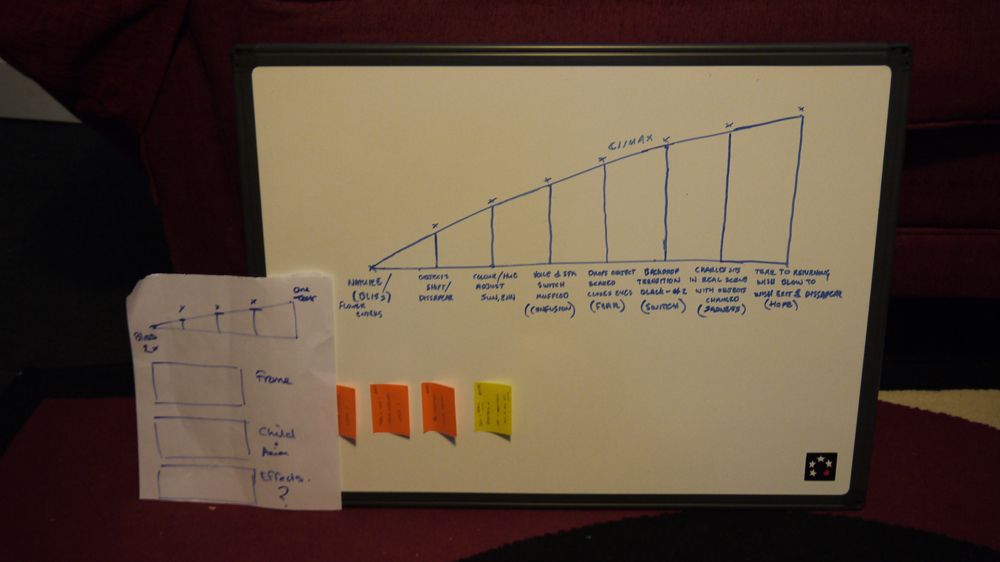
I have yet to run it by the girls but it has significant underpinnings which I really think work with our particular story... I haven't put it together based on nothing. Anyway after speaking with Alan on Thursday I decided to revisit the Script one last time and add some of the girls changes in also. I then got to asking myself about the trajectory of the story which Alan explained to us through a Grid... well I made one (see below)...

 
For those of you that cannot see the words on the image I projected the following transition throughout our entire sequence...
 
1. Nature/Flower Enters (Bliss)
2. Objects Shift/Disappear
3. Colour/Hue Adjust Sun/Env
4. Voice & SFX Switch Muffled (Confusion)
5. Drops Object Scared Closes Eyes (Fear)
6. Backdrop Transition Black - #2 (Switch)
7. Charles Sits In Real Scene With Objects Changed (Sadness)
8. Tear To Returning Wish Blow to Wish Exit & Disappear (Hope)
 
The script itself is sitting below here well the version 2.0 of it is anyway. I'm hoping that this is the final draft of the script but we will have to see. Well I had better get on with other things but I hope this script is more along the lines of what everyone was thinking at the meet yesterday.
 
I figure any other issues with the camera work etc of the script will be something we decide when we have the scene fully functional. Its kind of difficult to imagine every single second of this animation and how it will work that's why this Script or Script Final is to be considered a blue print to keep us on track nothing more... Not a definitive work.
 
Take it easy people!
 
xXStItChXx
Ashen Bloom Script V2

Thursday, 4 October 2012

Unit 7: Narrative - Week 2 Tutorial

For our second tutorial, we were prepared with a draft script (very close to being finalised) therefore, were able to spend time talking about the visual aspect of our animation. The points covered:

  • The animation starts with a happy, content boy. His lowest point is conveyed through a single tear. This change in emotion is only subtle therefore, we have to work on how we're going to  convey such minor changes and the appropriate times to show them. We chose to use a single tear rather than crying, as children would have be used to such situations and therefore, would be more accustomed to dealing with such emotions. There is less emotion however, this should hopefully make the viewer empathise more with the boy.
  • A toy could be used in the garden scene which in reality is part of the machine in the factory. The toy represents innocence and emphasises what childhood should be like.
  • How will the transition between the garden and factory work? Steam? Wind? The sun overburdens the scene? Morphing? Objects could slowing begin to change before the main transition. These changes would need to be so subtle that they are barely noticeable. Another idea is that the boy could look down when he drops the piece of metal, and when he looks back up, he is no longer in the garden, but in the factory which is in fact reality. 
  • If objects do begin to change before the main transition, we should consider the same effect created by the candle with 2 faces, as seen below. The viewer cannot see the candle and faces at the same time. The brain can only register one at a time. This effect can be used in the transition. Is the viewer seeing the garden or factory?

  • Other gradual changes in environment involve colour. The animation could start bright and become more dull. Also, the copper colours that are intended to be used in the factory could begin to be introduced in the garden scene. The viewer would be unaware of the true meaning of the colour introduction until the reality is revealed.
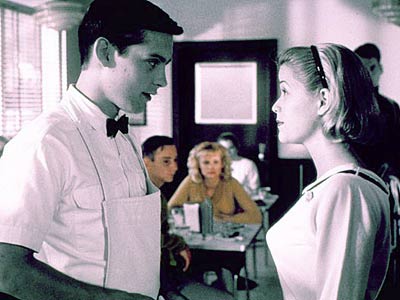
  • Render the garden and factory scenes twice, each with different lighting or in a different colour therefore, we can begin to experiment with masking areas. Examples of a similar technique can be found in Pleasantville (1998). The two images below show examples of colour introduced in a black and white environment. Throughout the film, the colour introduction is so subtle that the viewer begins to question whether it is part of the imagination of if there is a change of colour. This could tie in well with our animation.


Other references:

  • Chernokids (2010) could be useful when designing the factory and is an example of transition used in film.


  • War Horse (2011) for reference regarding colour used in scenes

To do over the next week:
  • Test types of transitions and find which is the most appropriate
  • Finalise script
  • Storyboard
  • Concept art and turnarounds
  • Animatic