Showing posts with label Ideas. Show all posts

Friday, 12 October 2012

Unit 7: Narrative - Week 3 Tutorial

On Thursday, we had a group meeting with our tutor, Alan, in which some of the following points were raised:
  • "Reduction is the way to go". Consider less camera movements and less cutting. If there are cuts, there should be a reason for them.
  • We were worried that transitions in the background would be too obvious e.g. a tree transforming into a metal pipe. However, Alan suggested watching the video below to emphasise the point that if the viewer is distracted in the foreground, changes can be made without being noticed.
                               
  • How much is the boy, Charles, going to move? Is he going to be static? Running around?
  • Could the boy be walking with objects changing around him? This is a similar idea to a scene from Fight Club (1999).
          

Unit 7: Narrative - Rough Initial Storyboard

Before Stitch began creating the final storyboard for the animatic, me and Lydia drew out how we visualised the storyboard (unfinished). This was then passed on to Stitch to draw up the final version which is currently being finished off and will be posted soon.


Thursday, 4 October 2012

Unit 7: Narrative - Week 2 Tutorial

For our second tutorial, we were prepared with a draft script (very close to being finalised) therefore, were able to spend time talking about the visual aspect of our animation. The points covered:

  • The animation starts with a happy, content boy. His lowest point is conveyed through a single tear. This change in emotion is only subtle therefore, we have to work on how we're going to  convey such minor changes and the appropriate times to show them. We chose to use a single tear rather than crying, as children would have be used to such situations and therefore, would be more accustomed to dealing with such emotions. There is less emotion however, this should hopefully make the viewer empathise more with the boy.
  • A toy could be used in the garden scene which in reality is part of the machine in the factory. The toy represents innocence and emphasises what childhood should be like.
  • How will the transition between the garden and factory work? Steam? Wind? The sun overburdens the scene? Morphing? Objects could slowing begin to change before the main transition. These changes would need to be so subtle that they are barely noticeable. Another idea is that the boy could look down when he drops the piece of metal, and when he looks back up, he is no longer in the garden, but in the factory which is in fact reality. 
  • If objects do begin to change before the main transition, we should consider the same effect created by the candle with 2 faces, as seen below. The viewer cannot see the candle and faces at the same time. The brain can only register one at a time. This effect can be used in the transition. Is the viewer seeing the garden or factory?

  • Other gradual changes in environment involve colour. The animation could start bright and become more dull. Also, the copper colours that are intended to be used in the factory could begin to be introduced in the garden scene. The viewer would be unaware of the true meaning of the colour introduction until the reality is revealed.
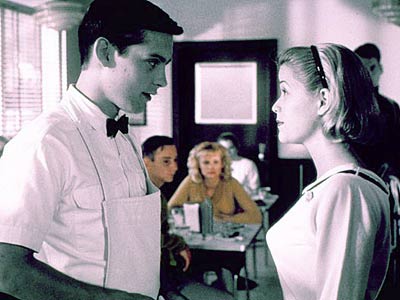
  • Render the garden and factory scenes twice, each with different lighting or in a different colour therefore, we can begin to experiment with masking areas. Examples of a similar technique can be found in Pleasantville (1998). The two images below show examples of colour introduced in a black and white environment. Throughout the film, the colour introduction is so subtle that the viewer begins to question whether it is part of the imagination of if there is a change of colour. This could tie in well with our animation.


Other references:

  • Chernokids (2010) could be useful when designing the factory and is an example of transition used in film.


  • War Horse (2011) for reference regarding colour used in scenes

To do over the next week:
  • Test types of transitions and find which is the most appropriate
  • Finalise script
  • Storyboard
  • Concept art and turnarounds
  • Animatic

Friday, 28 September 2012

Unit 7: Narrative - Story/Style Ideas

Despite there being many positives during The Industrial Revolution, there were also a number of negatives which stand out for story ideas. During group discussions, we were pretty certain that we wanted a child to be the focus of the animation. One thought was that the secondary character could be a dog therefore, one of my story ideas was to show the relationship between the boy and dog, with the story ending in tragedy e.g. the death of the dog or boy. This could be due to the work or a disease which was common during that era. A child used in such a scenario would heighten the emotion stirred in the viewer. However, we came to the conclusion that such a story in which a relationship has to be built would not be best in a short animation.
In the meantime I was also researching style ideas, particularly drawn to work by Sam Bosma (work on previous post), giving me the idea of a pop up style animation using muted colours and stylised imagery influenced by the artist mentioned. However, while this is a possibility, further ideas seemed as though they would work better as a full 3D animation.
After a tutorial with our tutor, Alan, we realised one thing, that all the group members were touching on the idea of freedom vs. entrapment. Discussion then became focused on the idea of depicting a young boy's imagination throughout the animation. The audience believe that the boy is in a happy, peaceful environment, discovering towards the end that he is in fact working in an industrial factory His wild imagination saving him from the horrid truth. All agreed on a story idea, the script writing begins, as well as research into what the style of the animation will be.